Hidden Risks in Pirated App Ecosystems
A Comparative Analysis of Permissions, Storage Access and Runtime Behavior
Introduction & Research Scope
▲Modified Android apps promise unlocked features, fewer advertisements or altered gameplay. The same distribution chain can introduce unfamiliar code, a different signer and new access requests. This study asks how those changes can be investigated through app identity, permission state, file activity and runtime observations.
Privacy Peek established the instrumentation: a privileged Android app paired with the FaNoMonitor filesystem logger on rooted devices. This follow-up applies that framework to the surrounding ecosystem, including HappyMod, Lucky Patcher, other mod APK catalogs and redistributed copies.
Research questions
- How do APK identity, signing provenance, declared permissions and granted access differ between comparable official and modified builds?
- Which file operations and background behaviors differ under the same scripted tasks?
- What additional evidence separates an unexplained observation from a demonstrated privacy violation?
Here, official means a build traceable to its developer's distribution channel. Modified means a build with altered code or resources. Pirated describes unauthorized redistribution or circumvention; it is not a technical malware classification. An independently distributed or open-source APK should not be categorized as pirated merely because it is outside Google Play.
Compare Two APKs
▲Compare a modified APK with a reference copy of the same app. See differences in signing identity, requested permissions, manifest settings and packaged files. The APKs are inspected without being installed or run.
This is a static comparison, not a malware verdict or a measurement of runtime behavior. A matching application ID does not establish authenticity.
Checking comparison availability…
Comparison Report
Share this link only with people who should see the report. The service does not publish a searchable report list.
The Modified-App Ecosystem
▼The original ModZoo study examined a September to December 2022 market collection. Its market analysis discussed HappyMod, MODDROID, APKMODY, androeed, RevDl, AN1, Appvn and the related Jojoy distribution channel. This establishes historical context, rather than their current inventory or security status. [1]
| Channel or tool | Role in this study | Evidence to preserve |
|---|---|---|
| HappyMod | A catalog and distribution channel for modified APKs, represented in ModZoo's historical sample. | Exact listing, capture time, claimed modification, download route, APK hash and signer. |
| MODDROID, APKMODY, androeed, RevDl, AN1, Appvn, Jojoy | Additional historically discussed mod-app distribution channels. Listings and files must be evaluated individually. | Track duplicate hashes across sources; the same binary is not an independent sample each time it appears. |
| Lucky Patcher | An on-device patching tool associated with license-check circumvention, rather than an equivalent APK catalog. | Separate the tool's behavior from the resulting patched APK. Record tool version, input/output hashes, root state and resulting signer. |
| Forums, messaging channels and mirrors | Potential redistribution routes in the threat model; no channel-specific findings are asserted here. | Preserve the chain of redirects and distinguish uploader claims from verifiable developer provenance. |
ModZoo also identified byte-identical copies across markets and distinguished forms of modification. Accordingly, the proposed dataset separates unchanged redistribution, resource-only changes and executable-code changes. A site label alone cannot establish what changed inside an APK. [1]
Why Lucky Patcher needs its own category
Google's 2017 Android Security Year in Review discussed Lucky Patcher as a tool users might knowingly install to modify apps and bypass license verification, while noting its ability to disable Android security settings. This is a historical characterization, not an assessment of every current version or every APK bearing that name. [2]
In the threat model, a lookalike download page can falsely claim to distribute any popular tool. That is a provenance concern to test, not evidence that a specific current Lucky Patcher distributor is malicious. The patching tool, the downloaded installer and the patched target app are three distinct artifacts.
Threat Model & Trust Boundaries
▼The central risk is a change in who controls the code and its future updates. A repackager could alter logic, add an SDK or stage a later download. A distributor could serve a different binary than its description suggests. These are candidate failure modes; their presence must be established for the specific sample.
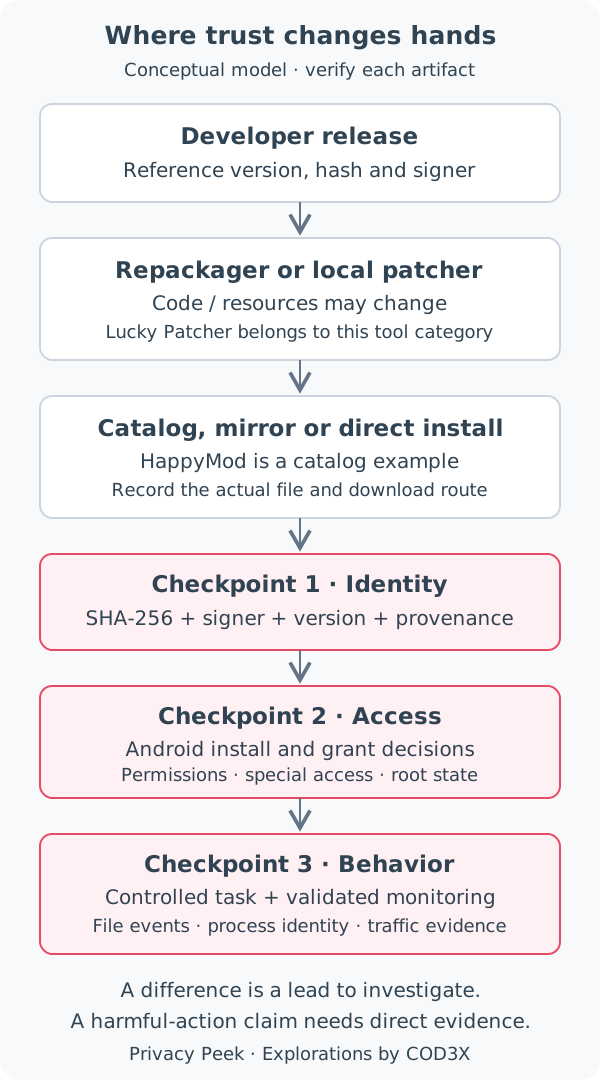
Signing identifies a build's trust relationship
Android requires signed APKs. Compare the signing certificate and any verified signing lineage against the developer's reference, rather than trusting an icon or package name. A changed signer is evidence of a changed signing identity; it does not by itself prove malware. Android supports legitimate signing-key upgrades, which must be considered during comparison. Android app-signing documentation. [3]
A documented mechanism, with a bounded conclusion
Kaspersky's original investigation of FMWhatsApp 16.80.0 reported a Triada component introduced through an advertising SDK, followed by additional payload downloads. It demonstrates how a modification can add a separate supply chain inside an app. The finding concerns that analyzed version; it is not evidence that every messaging mod, HappyMod listing or patching tool contains Triada. Original FMWhatsApp investigation. [4]
Reproducible Comparison Methodology
▼The following is the planned protocol for a Privacy Peek paired study. It is specified here so subsequent measurements can be audited and reproduced.
1. Establish sample identity
Pair the developer-distributed build with a modified variant of the same application. Match version code, version name, architecture, language resources and feature availability where possible. Record package name, SHA-256, certificate fingerprint, target SDK, acquisition date, source route and the advertised modification. Preserve the original APK or complete split-APK set. If a version match is unavailable, analyze that pair separately and report the mismatch.
2. Define independent samples
Deduplicate by APK hash while retaining every source observation. Treat applications as the main sampling unit, with variants and repeated runs nested underneath them. A single APK copied to five sites should not count as five independent confirmations. Predefine app categories and selection rules before collection so popular games do not dominate an ecosystem-wide claim.
3. Freeze the device environment
Record device model, Android build, kernel version and configuration, Magisk version, SELinux mode, monitor version, enabled event masks, watched mounts and network conditions. Use disposable lab devices, synthetic files and test accounts. Restore the same clean state before each build; do not run both variants against reused app data. Retain a monitor-only baseline to identify instrumentation activity.
4. Run the same tasks
Script first launch, denied-permission launch, a common foreground task, a fixed idle period and a second launch. Fix observation durations and input data. Record exactly when access is granted or denied. Randomize official/modified run order, repeat each scenario at least three times and record crashes, blocked installations and missing features rather than silently excluding them. Account-dependent behavior should use equivalent synthetic accounts.
5. Collect complementary evidence
Capture manifest and signer differences, permission snapshots, relevant AppOps observations when available, supported filesystem events, process identity and per-UID network counters. An independently instrumented network capture may add endpoint and timing evidence. Record encryption, visibility gaps and collection failures; byte counters alone cannot identify a destination or payload.
6. Preserve an auditable result
Export sanitized event records linked to sample and run IDs, alongside task timestamps and the environment manifest. Publish the matching rules, exclusions, aggregation code and event-loss indicators. Keep failed or unattributed observations visible. Report app-level paired differences and their uncertainty; do not interpret thousands of repeated events from one app as thousands of independent samples.
Permissions, Storage & Runtime Analysis
▼Declared, granted and observed are different states
A manifest lists requested capabilities; the device records whether access is granted; an observation may show use during a task. These states must be reported separately. Android distinguishes install-time, runtime and special permissions, so a raw permission count is an incomplete measure of access. Android permission model. [5]
Record special access such as drawing over other apps and all-files access independently from runtime permission dialogs. Also record whether an accessibility service, notification listener or root grant is enabled, rather than treating every capability as a normal manifest grant. Android documents separate Settings flows for special permissions. Special-permission workflow. [6]
Interpret storage in its platform context
Distinguish an app's own data and cache from shared media, user-selected documents and unrelated synthetic canary files. Android version and target SDK affect storage rules; Android 11 enforces scoped storage for apps targeting that release and restricts access to other apps' directories. The same declared permission can therefore have different effects across devices. Android 11 storage changes. [7]
Measure the monitor's coverage
FaNoMonitor sees only events supported by the actual kernel and selected fanotify marks. Upstream fanotify added create, delete and move event support in Linux 5.1; the Privacy Peek article's 3.18/4.9 devices cannot be assumed to support those events without verified backports. Validate coverage with known test operations and preserve queue-overflow or missing-attribution flags. Map an event's PID to UID/package promptly and retain unresolved events. Linux fanotify reference. [8]
Filesystem notifications do not reveal the exact bytes read, application intent or network payload. A system service can perform work on an app's behalf and shared UIDs or short-lived processes can complicate attribution. Correlate timestamps and tasks, then state the remaining uncertainty.
| Observation | Evidence needed | Alternative explanation or limit |
|---|---|---|
| Additional permission | Manifest diff, grant state, relevant task and observed use. | A changed feature or bundled library may explain the declaration; declaration is not use. |
| Different signer | Reference certificate, signing lineage and exact version match. | Repackaging or legitimate key migration; signer identity alone does not establish intent. |
| Unrelated file access | Validated event coverage, file category, process attribution and repeatable task correlation. | Cache, media indexing or a delegated service may account for activity. |
| Background network traffic | Per-run baseline, UID attribution, endpoint/timing data and content evidence when available. | Synchronization, ads, updates or telemetry; an upload counter does not prove exfiltration. |
| New code or staged download | Code/resource diff, loaded artifact hash and observable execution chain. | Assets and ordinary updates must be separated from executable payloads. |
| No recorded events | Positive coverage control and a successful, sufficiently long task run. | Unsupported masks, unmarked paths, delayed execution or evasion can create false reassurance. |
Evidence & Current Findings
▼What the available evidence supports
- Ecosystem diversity: Published market research supports treating catalogs, copied APKs and different modification types separately. [1]
- A concrete supply-chain mechanism: The analyzed FMWhatsApp version shows how an added SDK can introduce staged malicious behavior. [4]
- A measurable comparison: Android access state and validated filesystem observations can support a controlled study, with explicit coverage limits. [5] [8]
What remains to be measured
The Privacy Peek development article mentions an initial 42-application analysis. Its underlying sample manifest and raw traces are not included with this follow-up, so that mention is not treated as a verified paired dataset here. Permission deltas, storage-event rates, network differences and per-source prevalence remain unmeasured for this article. No numerical comparison chart is presented without those artifacts.
A future results release should include per-pair sample identities, exact test conditions, missing-data counts, repeat-run variation and confidence intervals with the analysis code. Any risk claim should point to the specific build and observed behavior, rather than assigning a single score to an entire site.
Discussion & Practical Implications
▼The useful question is whether a build's origin and behavior justify the access it receives. “Premium unlocked,” community ratings and a familiar icon are claims to investigate. Equally, an official distribution channel does not remove the need to evaluate permissions and data handling.
For users, prefer a developer-verifiable release and an update path whose signer can be checked. Review unexpected access requests in relation to the app's purpose. Keep platform protections enabled: Google states that Play Protect checks apps from outside Google Play as well as those from its store and can warn about, disable or remove potentially harmful apps. A completed scan is not a guarantee about all future behavior. Google Play Protect documentation. [9]
For researchers, give each finding an evidence level: identity difference, access capability, observed behavior or confirmed harmful action. Escalate a claim only when the supporting artifact supports that level. A file read followed by traffic is a lead; proving a sensitive file was transmitted requires a defensible link between its content and the transfer.
Limitations & Next Steps
▼- Instrumented environment: Root, privileged APIs and permissive SELinux can change behavior and security boundaries. Results from these devices need separate validation on a representative stock-device setup.
- Version and time: Historical papers and malware cases do not describe every current download. Record acquisition times and avoid transferring a finding between versions.
- Incomplete execution: Login requirements, region checks, delayed tasks and anti-analysis behavior may prevent a relevant code path from running.
- Attribution and visibility: Kernel support, event loss, delegated I/O, encrypted traffic and process races limit what the monitor can establish.
- Selection and confounding: Category, version, target SDK and advertised modifications can explain differences. Site-level conclusions require a defensible sampling frame and independent observations.
The next step is to publish a small, fully documented paired pilot before expanding collection. Validate event masks on each device, release a sanitized sample manifest and run the same tasks on both instrumented and stock configurations. Larger-scale conclusions should follow only after the pilot establishes measurement reliability.
Conclusion
▼Modified-app ecosystems add trust decisions at the repackager, distribution, installer and runtime stages. HappyMod-style catalogs and Lucky Patcher-style local patching occupy different parts of that chain. Their risks should be assessed using identifiable artifacts and observable actions.
Privacy Peek provides a foundation for comparing those actions. This follow-up defines how to pair builds, control experiments, interpret access signals and publish evidence without converting suspicion into a malware verdict. Its empirical comparison remains future work.
References
▼Primary sources and platform documentation. Historical findings are identified by their publication or collection period in the article.
- ModZoo: A Large-Scale Study of Modded Android Apps and their Markets. Original research, 2024, version 2.
- Google. Android Security: 2017 Year in Review, Lucky Patcher discussion, printed page 46.
- Android Developers. Sign your app.
- Kaspersky Securelist. Triada Trojan in a WhatsApp mod, original investigation, 2021.
- Android Developers. Permissions on Android.
- Android Developers. Request special permissions.
- Android Developers. Storage updates in Android 11.
- Linux man-pages. fanotify(7).
- Google Play Help. Use Google Play Protect to help keep your apps safe and your data private.